
Scaling L4 Robotaxis: A Technical Breakdown of the NVIDIA DRIVE and Halos Stack

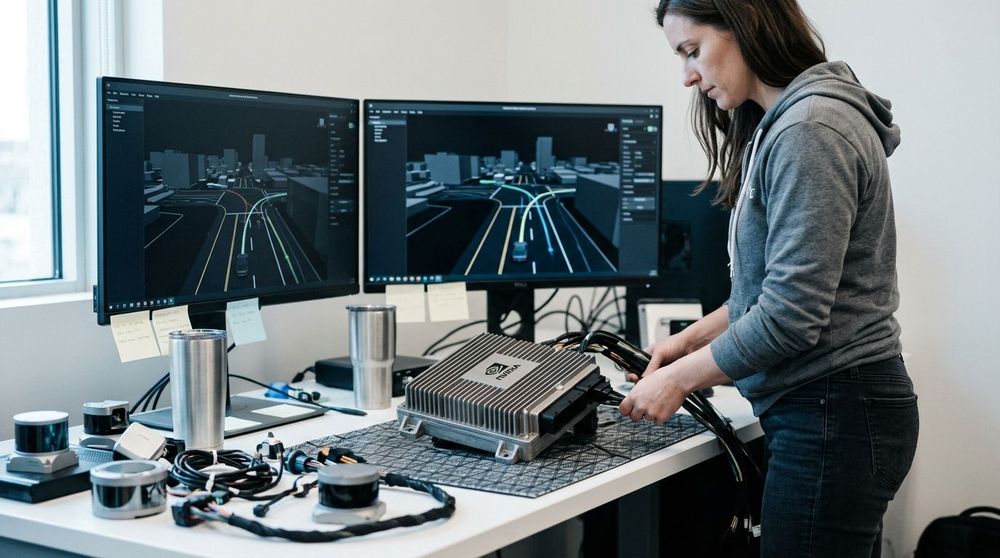
Getting Level 4 robotaxis deployed at scale requires a common, powerful, and verifiable platform. Moving from a handful of prototypes to a city-wide fleet depends on having an integrated system that covers everything from in-car compute and a safety-certified OS to the cloud backend where the AI models are built. NVIDIA is positioning its DRIVE and Halos platforms as that end-to-end solution.
In-Vehicle Compute: DRIVE AGX Hyperion 10
The core of NVIDIA’s reference design for production L4 vehicles is the DRIVE AGX Hyperion 10 platform. The system is built around two DRIVE AGX Thor systems-on-a-chip (SoCs), which are based on the company's Blackwell architecture.
- Compute Performance: Each SoC provides over 2,000 FP4 teraflops (or 1,000 INT8 TOPS). That level of performance is needed to handle real-time sensor fusion and run complex AI models.
- Sensor Suite: To speed up development, the platform includes a pre-qualified set of sensors. The standard setup includes 14 cameras, 9 radars, 1 lidar, and 12 ultrasonic sensors.
Software Foundation: Halos OS and SDK
The hardware is managed by the NVIDIA Halos Operating System, a software foundation built in layers for reliability.
- Halos Core: As the successor to NVIDIA DriveOS, Halos Core is certified to the ISO 26262 ASIL D automotive safety standard. It uses a hypervisor to isolate safety-critical functions from other software, preventing a fault in a non-critical app from affecting core driving systems.
- Halos SDK: This middleware layer creates a buffer between the autonomous driving software and the car’s specific hardware. This means the core AV stack doesn't need to be rewritten for different vehicle models. The SDK also includes a deterministic scheduler for predictable performance and zero-copy data transfer to minimize latency.
On top of this foundation sits the Halos Applications layer, which runs rule-based safety features like automatic emergency braking. These systems operate as a safeguard alongside end-to-end AI models, like the NVIDIA Alpamayo family, which uses chain-of-thought reasoning to plan its driving decisions.
Data Center Backend: Training and Validation on Halos Infra
The AI driving models are developed and validated in the cloud on the Halos Infra platform. This backend infrastructure supports the entire machine learning lifecycle, from training models on NVIDIA DGX systems to large-scale validation in NVIDIA Omniverse. To train the AI on rare "long-tail" scenarios, the OmniDreams world model can generate photorealistic, synthetic driving data. For testing, the AlpaGym framework connects the AI directly to high-fidelity simulations for continuous, scaled-up reinforcement learning.
From 32B-Parameter Models to Low-Latency Inference
NVIDIA's Alpamayo 2 Super is a 32-billion-parameter Vision-Language-Action (VLA) model that provides the system with advanced reasoning skills. A model that large, however, is too big to run efficiently inside a car. To solve this, NVIDIA distills it into smaller, more compact versions that are optimized for the DRIVE AGX Thor hardware.
To meet the strict, real-time latency demands of driving, NVIDIA's LCDrive architecture replaces computationally heavy text-based reasoning with compact latent representations. The company claims this technique reduces the amount of data needed for a reasoning loop by about half, allowing for much faster decision-making on the road.
Ecosystem Adoption and Verification
This full-stack approach is gaining traction with several major players. Uber plans to use the platform to scale its mobility network, targeting up to 100,000 L4-ready vehicles starting in 2027. Foxconn is using DRIVE Hyperion for L4 electric robotaxis in Taiwan, with a launch planned for 2028. VinFast and Autobrains are working to bring L4 vehicles to Southeast Asia, while Uber and Autobrains are also launching a robotaxi program in Munich. Other partners like Humain, Stellantis, Lucid, and Mercedes-Benz are also building their AV systems on the NVIDIA DRIVE platform.
To complete the process, the ANAB-accredited NVIDIA Halos AI Systems Inspection Lab provides partners with a formal pathway to verify that their systems are integrated safely.

Related articles

Securing Autonomous AI: HPE and Nvidia Launch Compliant Infrastructure for Enterprise Agents
HPE & Nvidia launch compliant infrastructure for autonomous AI agents, ensuring security with hardware enclaves, zero-trust, software guardrails & monitoring.


Enterprise AI Architecture: Deploying Partner Networks and Agentic RAG Pipelines
OpenAI's $150M Partner Network trains 300K consultants to tackle enterprise AI integration, deploying structured architectures and RAG pipelines.


Regulatory Intervention and Export Controls: Analyzing the Global Suspension of Anthropic’s Fable 5 and Mythos 5
Anthropic's Fable 5 & Mythos 5 models suspended worldwide by US Commerce Dept. over national security, a jailbreak, and export control issues. Highlighting enterprise AI risks.